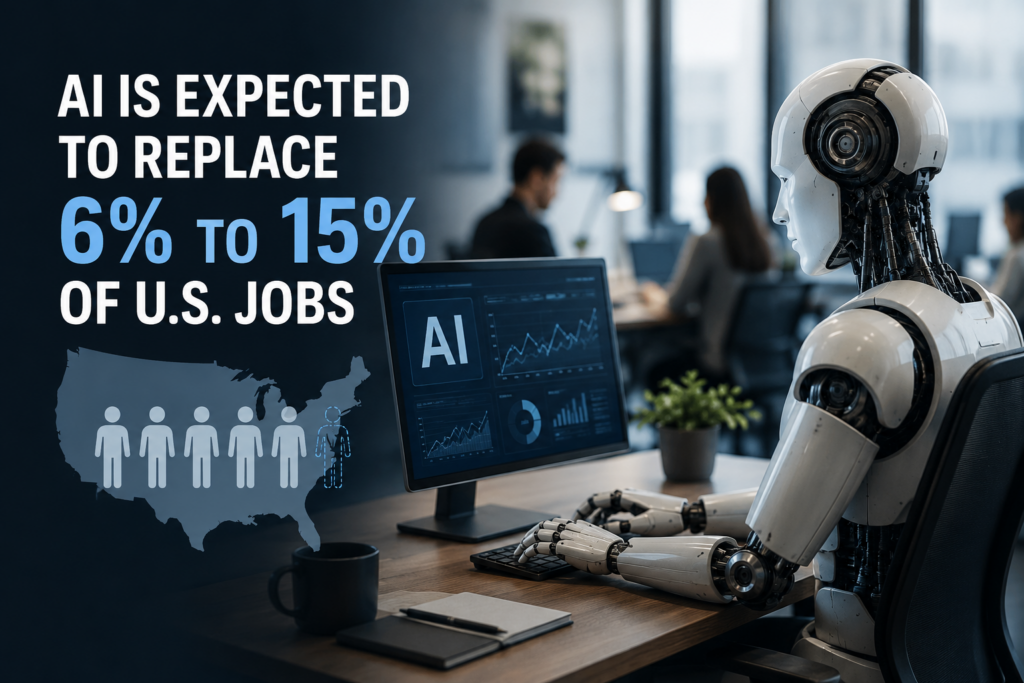
AI is expected to replace roughly 6% to 15% of U.S. jobs, with up to 300 million jobs affected globally
Published by RawNews1st
7:28 AM ( May 16, 2026 )
AI is expected to replace roughly 6% to 15% of U.S. jobs, with up to 300 million jobs affected globally by the early 2030s. However, rather than outright replacing entire professions, AI is primarily expected to reshape and augment the majority of roles.
60% will see significant task-level changes due to AI integration. This shift highlights the urgent need for workers to adapt through upskilling and technological proficiency.
AI is accelerating automation across sectors, with profound implications for employment in the United States. From job losses and workforce reductions to shifting career paths and retraining needs, these statistics outline the scale and speed of AI’s disruption.
General AI Impact on the U.S. Job Market
- 30% of current U.S. jobs could be automated by 2030; 60% will have tasks significantly modified by AI.
- 300 million jobs could be lost to AI globally, representing 9.1% of all jobs worldwide.
- 23.5% of U.S. companies have replaced workers with ChatGPT or similar AI tools.
- 49% of companies using ChatGPT say it has replaced workers.
- In May 2023, 3,900 U.S. job losses were directly linked to AI, making it the seventh-largest eliminator of jobs that month.
- 13.7% of U.S. workers report having lost their job to a robot or AI-driven automation.
- Since 2000, automation has resulted in 1.7 million U.S. manufacturing jobs lost.
- 40% of employers expect to reduce their workforce where AI can automate tasks.
- By 2030, 14% of employees globally will have been forced to change their career because of AI.
- 20 million U.S. workers are expected to retrain in new careers or AI use in the next three years.
- 30% of U.S. workers fear their job will be replaced by AI or similar technology by 2029.
- Automating half of current tasks worldwide could take another 20 years.
- Entry-level jobs are especially vulnerable, with nearly 50 million U.S. jobs at risk in coming years.
- As entry-level roles decline, salary expectations are also shifting downward.
- AI could impact nearly 60% of jobs in advanced economies, but only 26% in low-income countries.
- AI’s impact is expected to be most disruptive in the next 10–30 years, with a possible 50% of jobs automated by 2045
McKinsey global institute says that at the global average level of adoption and absorption and advances in ai implied by their simulation, AI has the profound impact to deliver additional global economic activity of around $13 trillion in the foreseeable future and by 2030, or about 16% higher cumulative GDP compared with today.
This amounts to 1.2% additional GDP growth per year. If delivered, this impact would compare well with that of other general-purpose technologies through history. This will mainly come from substitution of labor by automation and increased innovation in products and services.
The same report went on to say that By 2030, the average simulation shows that some 70% of companies will have embraced the ai revolution and adopted at least one type of AI technology but that less than half will have fully absorbed the five categories.
Forbes say ai has the potential to be among the most disruptive technologies across global economies that we will ever develop.
Renan Araujo, director of programs at the nonprofit Institute for AI Policy and Strategy, said the agent findings were notable: “One in 12 Americans has used an autonomous AI agent, a software that not just answers questions but takes actions on your behalf,” Araujo told NBC News. “This capability was not available two years ago, and it’s striking to see its usage grow so quickly.”
The Epoch poll also examined how American adults were putting AI to use. The survey found that many adults who used AI in the past week had used the services to look up information or recommendations (80%), write or edit text (59%) and brainstorm ideas (53%).
From the sample of roughly 2,000 adults, ChatGPT was the most popular AI service (used by 31%), followed by Google’s Gemini (21%) and Microsoft’s Copilot (10.5%).
Epoch’s survey comes on the heels of new reports from Goldman Sachs and Morgan Stanley addressing the growing specter of AI in the labor market.
Economists from Goldman Sachs published new findings this week that AI is eliminating around 16,000 jobs per month when accounting for both AI-caused automation and augmentation. The bank’s researchers had previously estimated in March that AI can potentially automate tasks that consume around 25% of all work hours.