Gold nanoparticles slash dendrite growth and boost zinc battery life to 6000 hours
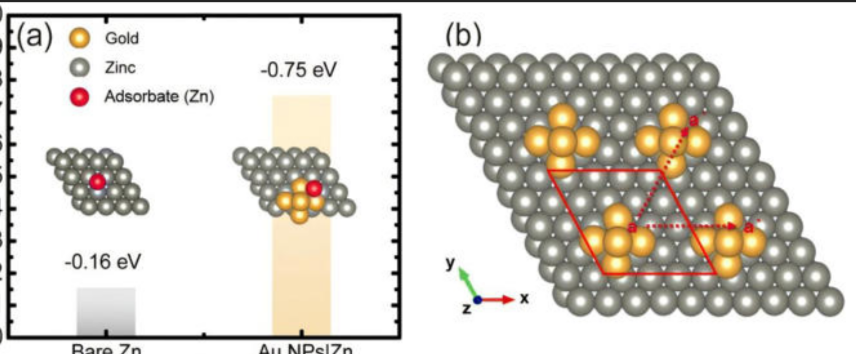
Now researchers from Concordia University have found a way to slow dendrite formation. Using the ultra-bright X-rays of the Canadian Light Source at the University of Saskatchewan, they found that “sprinkling” a small amount of gold nanoparticles on a battery’s inner surface can cut dendrite growth by up to 50 times compared to regular zinc batteries.
Their gold-treated batteries went on to work for more than 6,000 hours in lab settings.
“Coating the electrode is known to improve battery performance, but the small quantity of particles needed for our technique and how they are arranged on the battery surface is a very new, exciting finding,” says Seungil Lee, a Ph.D. student at Concordia and lead author of the team’s paper, published in the Journal of Materials Chemistry A.
Although gold is expensive, the technique the researchers developed—which sparsely distributes particles on less than 10% of the battery surface—could be relatively cheap to implement for large-scale battery applications.
“Because of the way that we make it, which doesn’t require any special lab conditions and only small amounts of gold, it just becomes dead cheap to put gold particles on the surface, it’s 1/100th of the price of regular gold coatings,” says Ayse Turak, Associate Professor, Physics, and Lee’s supervisor.