Why Pluto Is No Longer Classified as a Planet – The Truth Behind the Debate
Why Pluto Is No Longer Classified as a Planet – The Truth Behind the Debate
For decades, Pluto was celebrated as the ninth planet in our solar system. Children memorized its name, telescopes searched for its mysteries, and science books proudly listed it alongside giants like Jupiter and Saturn. But everything changed in 2006 when the International Astronomical Union (IAU) made a decision that shocked the world — Pluto was officially reclassified as a dwarf planet.
So why did Pluto lose its planetary status? The answer lies in science and definition. According to the IAU, for a celestial body to be a planet, it must meet three requirements:
- It must orbit the Sun.
- It must be spherical in shape (caused by its own gravity).
- It must clear its orbit of other debris.
Pluto easily checks off the first two boxes. It orbits the Sun and is round like a planet. However, it fails the third rule — it shares its orbit with other icy bodies and debris in the Kuiper Belt. Because it hasn’t “cleared its neighborhood,” scientists reclassified Pluto as a dwarf planet, along with others like Eris and Haumea.
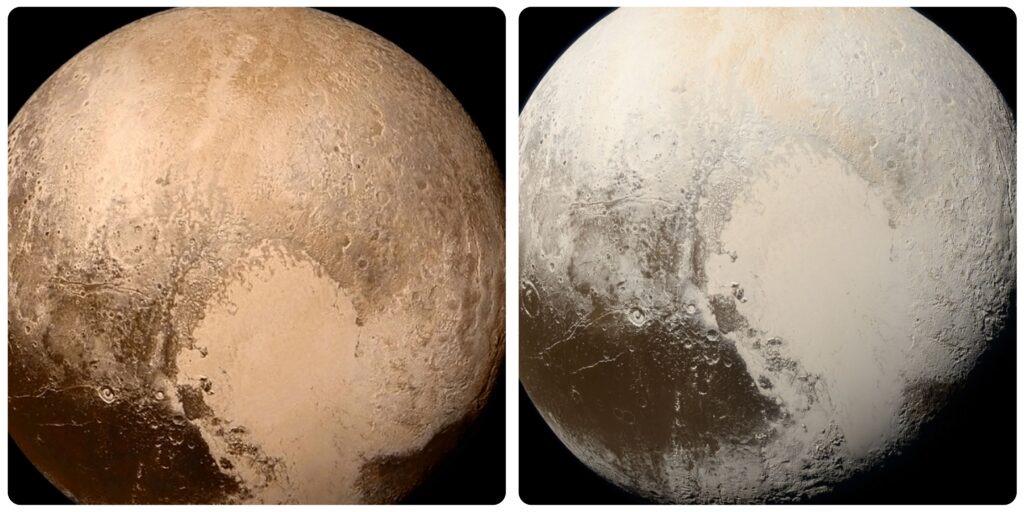
Despite this downgrade, Pluto remains one of the most fascinating objects in our solar system. NASA’s New Horizons mission revealed its icy mountains, possible subsurface ocean, and heart-shaped glacier — proving Pluto still holds cosmic secrets worth exploring.
Many astronomers and the public still argue that Pluto deserves to be called a planet again. Whether you call it a dwarf planet or the “ninth world,” one thing is clear — Pluto continues to capture our imagination.