Processed food makes up 58% of the average American diet: The countries that eat the most processed foods Ranked

The countries that eat the most processed foods — Ranked:
Processed food makes up 58% of the average American diet — and the UK isn’t far behind. In the United States, more than 40% of people are obese and 10% are morbidly obese.
Their high-calorie mix of refined carbs, fats, salt, and sugar—rarely found in nature—triggers cravings and overeating.
One study shows that people consuming ultra-processed diets eat an extra 1,000 calories per day compared to those on minimally processed diets. In particular, “hyperpalatable” foods like french fries strongly activate the brain’s reward system, making them especially addictive.
This graphic shows the share of ultra-processed food in adults’ diets across select countries, based on data from the British Medical Journal via BBC.
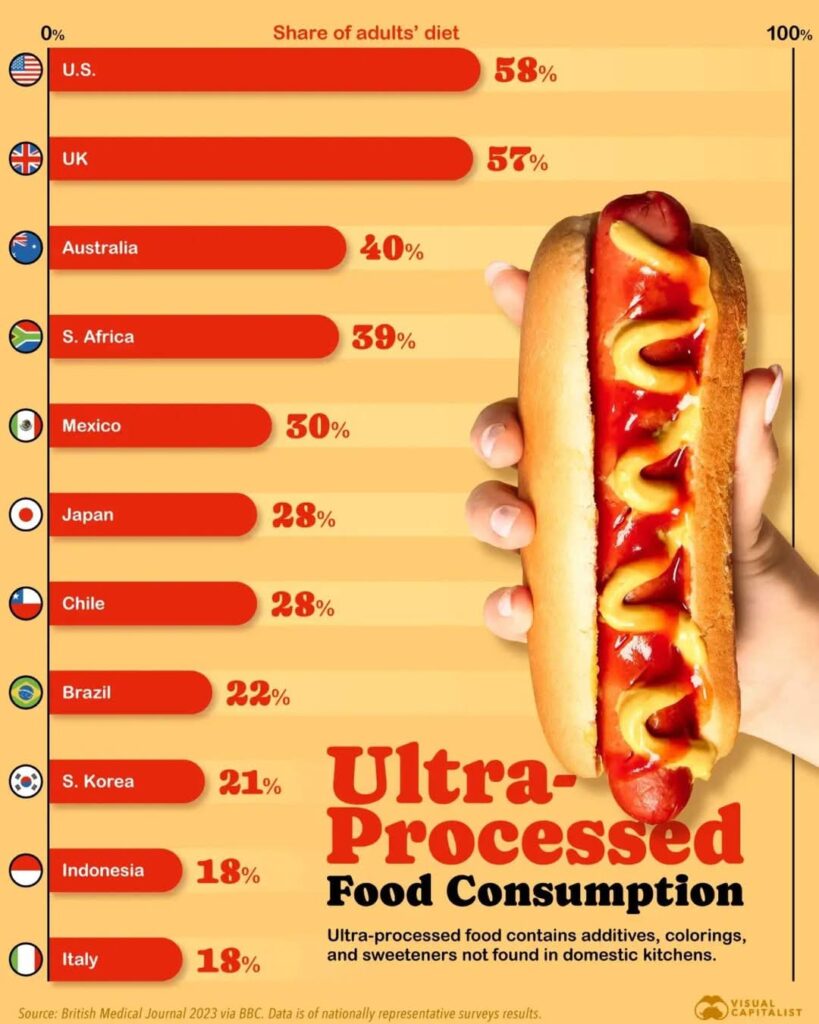
While there is no standard definition for ultra-processed foods, they typically contain additives, sweeteners, and chemicals not found in domestic kitchens.
These ingredients include emulsifiers and high-fructose corn syrup, which was introduced in the 1960s as a cheaper replacement for cane sugar. As the table below shows, they make up 58% of American adults’ diet based on nationally representative surveys.
In response, the newly appointed secretary of the U.S. Health and Human Services, Robert F. Kennedy Jr. plans to crack down on ultra-processed foods.
In particular, he has criticized the scale of additives in the American food supply, which have been shown to increase the risk of chronic health conditions, cancer, and fatty liver disease. He has also noted that U.S. food products often contain additives that are banned in Europe.
The UK follows closely behind America, with 57% of adults’ diets consisting of ultra-processed foods. More concerningly, this share jumps to 65% for children. Overall, the most popular ultra-processed foods in the UK are factory-made bread and pre-packaged meals.
As we can see, ultra-processed food diets are not exclusive to Western countries. In countries like South Africa, Mexico, and Japan, they make up at least 28% of total calaries consumed.